Explore our resources to discover insights, guides, and tools that can help your organization thrive. Learn More!
Top

Partner


For City Clerks:
What’s Next for Laserfiche?
From File Cabinet to Infrastructure
For years, organizations adopted Laserfiche to solve a very real problem: paper. They needed a better way to store information, reduce physical filing, and make documents easier to retrieve. But Laserfiche was never intended to be only a digital file cabinet. Nien-Ling Wacker designed Laserfiche as an auxiliary brain for the organization, a system that could help people capture, organize, retrieve, and act on information more intelligently.
And for many agencies, that first step was transformative.
But over time, we started noticing a recurring pattern in conversations with clients at conferences, user groups, and industry events. Someone would walk up to our booth and say some version of the same thing:
“We have Laserfiche. We like it. But we feel like we’re probably not using it fully.”
That question is more important than it sounds.
Because the journey from digital file cabinet to enterprise infrastructure does not happen all at once. Organizations do not jump from scanning paper directly into advanced integrations, trusted systems, and enterprise automation overnight. There are stages in between, and each stage changes the role Laserfiche plays inside the organization.
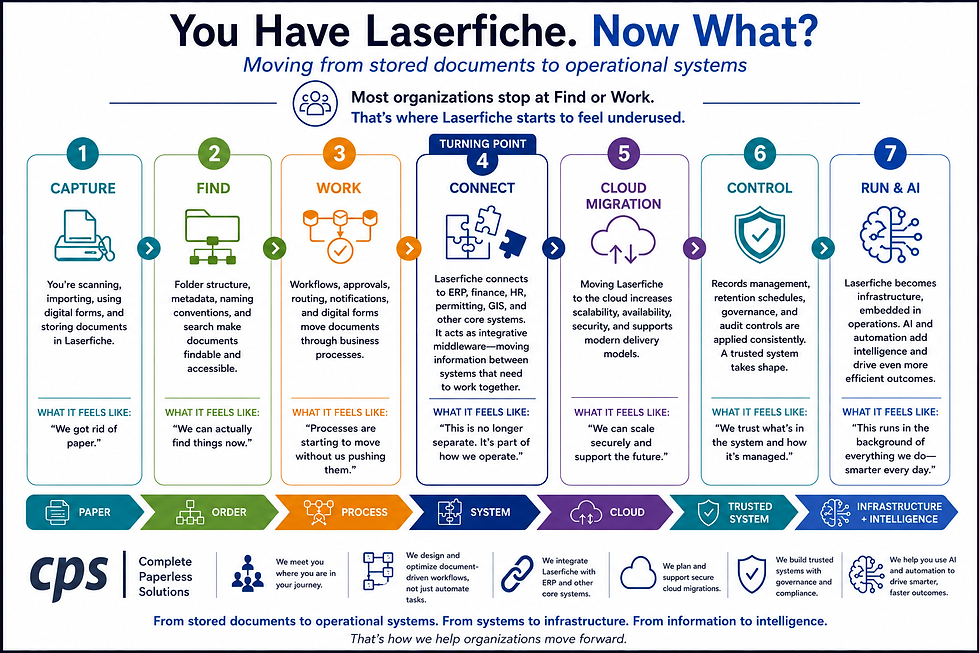
That is the idea behind the “You Have Laserfiche. Now What?” piece.
This is not a maturity model, scorecard, or consulting exercise. It is a practical conversation tool based on the progression we see real organizations move through over time.
.png)
The first stage is Capture. This is where organizations replace paper with digital documents through scanning, importing, forms, and centralized storage. For many agencies, this is the beginning of their digital transformation effort.
The next stage is Find. Once documents are centralized, structure becomes important. Folder structure, metadata, naming conventions, and search determine whether information is simply stored or truly accessible.
From there, organizations begin to Work differently. Documents no longer sit still; they move through workflows, approvals, routing, notifications, and digital forms. This is often where organizations begin to feel operational momentum.
The turning point is Connect. This is where Laserfiche begins integrating with ERP systems, financial systems, HR platforms, GIS, permitting systems, and other operational technologies. At this stage, Laserfiche can act almost like integrative middleware, helping information move between systems that were never designed to work together cleanly.
Control follows next. Records management, retention schedules, governance, and auditability become increasingly important as organizations scale their usage and depend more heavily on digital processes. This is where trusted system thinking begins to take shape.
Finally, organizations reach Run. At this point, Laserfiche is no longer simply where documents live. It becomes infrastructure, embedded in how departments function, communicate, and deliver services.
One of the reasons we wanted to create this piece is that many organizations stop somewhere between Find and Work. That is often the point where the system begins to feel underused, even though the platform itself is capable of much more.
Our goal with this framework is simple: to help organizations visualize what “next” can look like in a practical, approachable way.
Not every organization will move through these stages in the same order. Some may focus heavily on records management early. Others may prioritize workflow, digital forms, or integrations first. But the progression itself is something we see repeatedly across agencies of all sizes.
At CPS, these are the conversations we enjoy most because they move beyond software and into operational thinking. They become conversations about how information moves, how departments connect, and how organizations build systems they can trust long term.

Our story
Employee owned & operated
At CPS, we believe in the power of personal connections. Our company was founded on the principles of trust, relationships, and face-to-face meetings, a tradition that continues to this day. While we’ve embraced technological advancements, our commitment to personalized service remains unwavering. Our team, with its deep industry expertise and cutting-edge technical skills, is dedicated to helping organizations thrive digitally.
Our vision
We want to make a difference
Our vision at CPS is to empower our clients through digital transformation to achieve their full potential. We do this by providing innovative, tailored solutions that streamline operations, increase transparency, and drive success. We are deeply committed to building lasting partnerships, delivering exceptional service, and continuously evolving our expertise to meet our clients' ever-changing needs. By focusing on their goals and challenges, we aim to be the trusted partner that helps organizations grow, adapt, and thrive in a digital landscape.
